The embedded payroll category has matured fast. Five years ago, "payroll API" meant a thin wrapper around someone else's batch processor. Today, a handful of providers can spin up a tax-compliant payroll product behind your SaaS in weeks, not quarters.
Here's what the category doesn't talk about much: most embedded payroll APIs were architected around a specific kind of worker. Salaried, single state, single role, W-2, paid biweekly, no unusual deductions, no project tracking. That covers a big chunk of the U.S. workforce. It also misses the entire slice of the economy where vertical SaaS is winning right now, where embedded payroll's economics are most attractive, and where the operational complexity is highest.
If you're building software for construction, government contractors, staffing firms, manufacturing, field services, or any industry with skilled trades, your customers' payroll is not the easy case. It's the case where most embedded providers quietly fail.
What "complex payroll" actually means
Three flavors of complexity tend to break generic embedded payroll APIs. They often show up together.
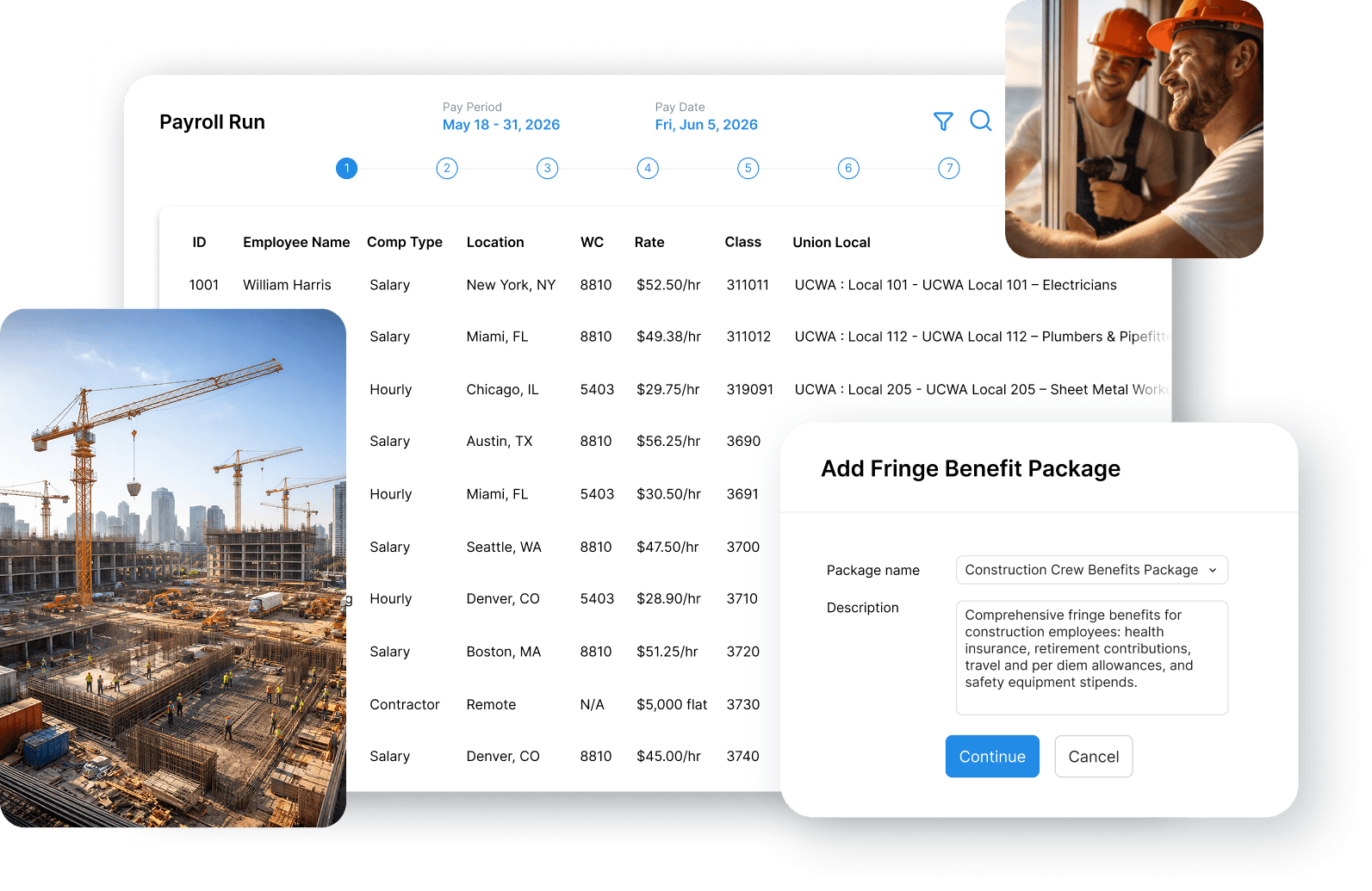
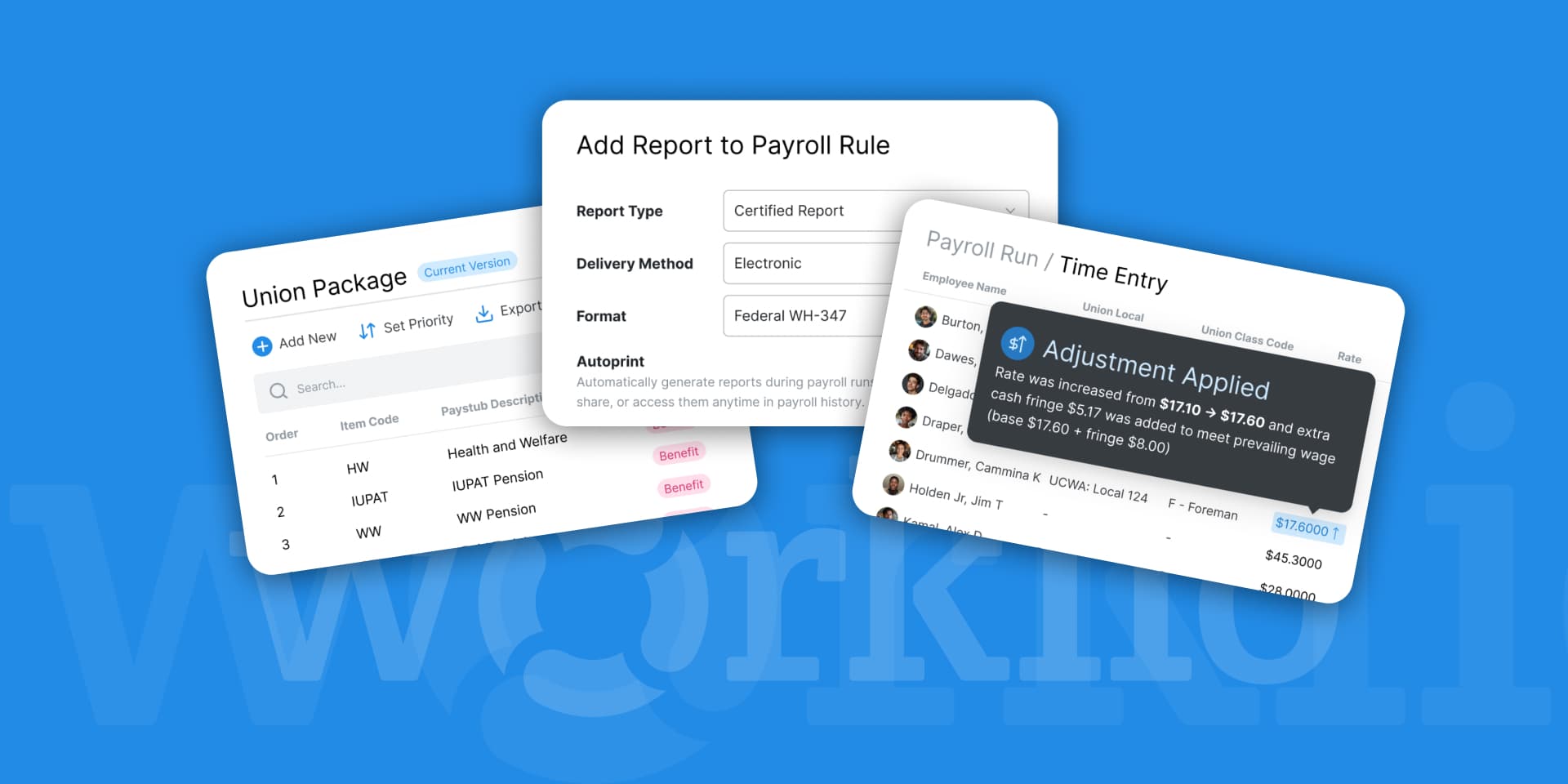
Certified payroll.Federally funded public works projects covered by the Davis-Bacon Act, and a long list of similar state and municipal statutes, require contractors to file weekly WH-347 reports. Each report has to show every worker on the project, their trade classification, hours worked, gross wages, fringe benefits paid in cash vs. into a plan, deductions, and net pay, alongside a signed statement of compliance. Get the format wrong and the prime contractor's payment gets held up. Get the math wrong and you're looking at back wages, penalties, and possible debarment.
Prevailing wage.Davis-Bacon and its state cousins (California Public Works requirements, New York Article 8, Massachusetts, Washington, dozens more) set a minimum hourly rate by trade, by county, by project type. The rates change. They can differ across two job sites in the same week. Workers who switch classifications mid-shift need their hours split correctly. Fringe benefits can be paid as cash on the paycheck or contributed to a bona fide plan, and the choice changes the worker's tax picture and the contractor's labor cost. None of this lives cleanly in a single "pay rate" field.
Union payroll. Collective bargaining agreements add another layer. Working dues calculated as a percentage of gross. Fixed-dollar initiation fees. Health and welfare, pension, annuity, apprenticeship training, and labor-management contributions, all going to different multi-employer funds with their own remittance schedules and formats. Market recovery deductions. Travel and subsistence pay. Foreman differentials. And in many trades, different rates for journeyman, apprentice, and helper, with apprentice ratios that have to be tracked and reported.
Add the fact that many of these employers run multiple legal entities (a non-union company, a union company, a project-specific JV) and a single weekly payroll can easily touch dozens of distinct calculations per worker.
Where most embedded payroll APIs break
Here's an honest list of the places generic embedded providers tend to fall over. None of these are exotic. They're routine for any construction or trades-heavy customer.
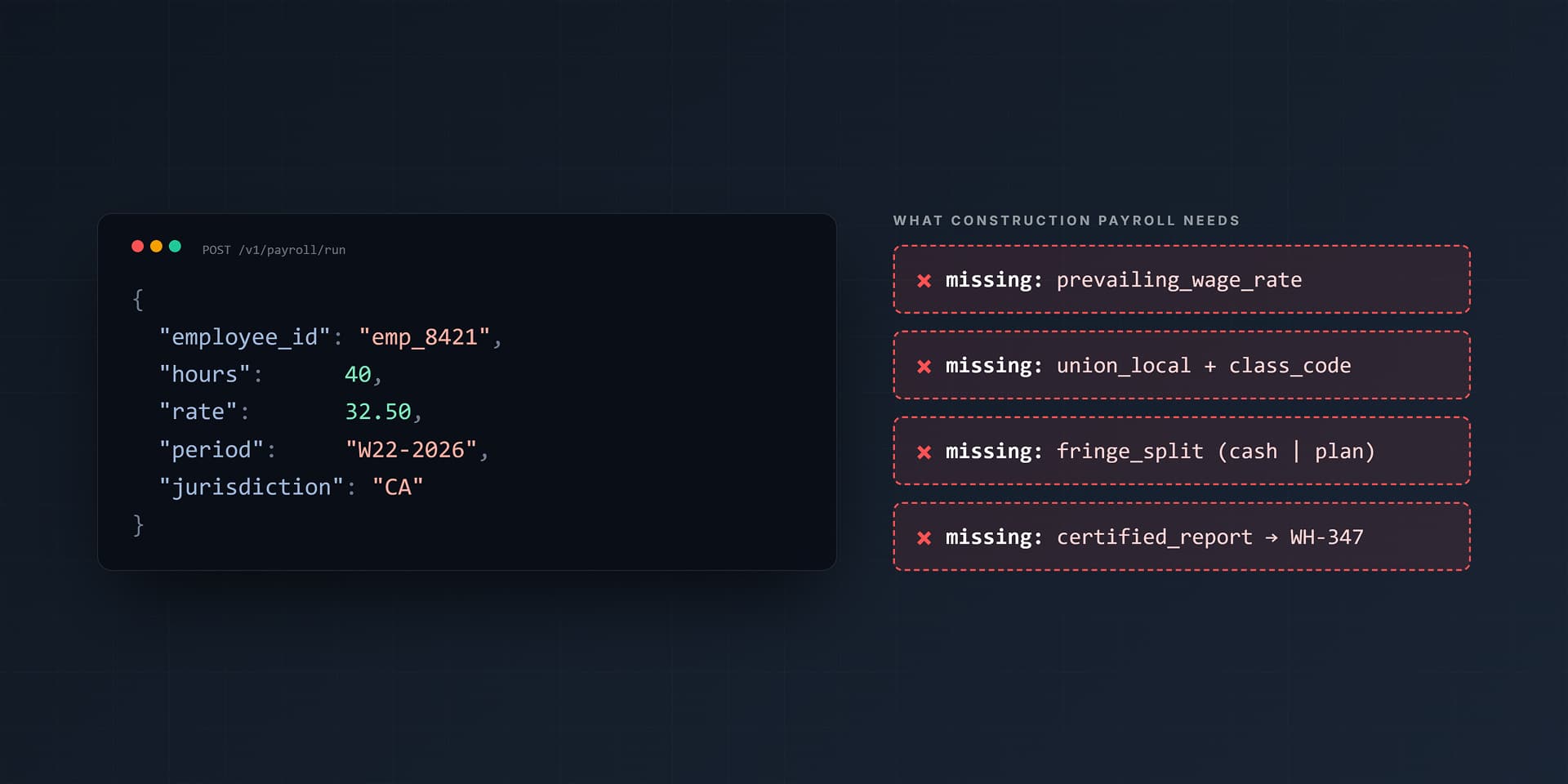
- Pay rates that vary by project, by location, and by trade classification, in the same pay period. Most APIs assume a worker has a pay rate. Trades workers have a matrix.
- Fringe benefits that can be paid as cash or as a plan contribution, sometimes split. This affects both the worker's gross and the employer's reported labor cost on the certified report.
- Workers who hold multiple classifications in a single week. A journeyman electrician on Monday and Tuesday, a foreman on Wednesday, training on Thursday. Each row needs its own rate and its own fringe treatment.
- Retroactive wage determination updates. Federal and state agencies update prevailing wage rates regularly. When a determination changes mid-project, you may owe back pay across many weeks. The system needs to reopen prior periods, recalculate, and produce corrected reports.
- Multi-EIN and multi-entity employers. Construction in particular is full of operating companies, holding companies, project-specific entities, and union/non-union splits within one ownership group. Generic embedded products often treat each EIN as a separate tenant, which breaks consolidated reporting, shared workforce, and inter-entity transfers.
- Union remittance reports. Each fund wants its own format. Some accept ACH and a CSV. Some still expect a specific PDF. The data has to be sliced by local, by fund, and by reporting period, which is often not aligned with the payroll period.
- Certified report output in the exact required format. WH-347 is the federal standard, but plenty of states and municipalities have their own variants. LCPtracker, eMars, and other state systems each have ingestion formats that have to match exactly.
- Job costing. Hours and wages need to flow to the right job, the right phase, and the right cost code, and that data needs to round-trip with the GC software, the ERP, or the project management tool.
If your embedded payroll provider does any of these poorly, the customer ends up running a parallel spreadsheet, or worse, churning to a legacy payroll bureau that "just gets it." Either way, your embedded payroll revenue line shrinks.
A buyer's checklist
If you're evaluating embedded payroll providers and any of your customers do public works, prevailing wage, or union work, here are the questions worth pressing on. The marketing pages won't answer most of these. The implementation team will.
- Can a single worker have different pay rates and fringe rates per project and per classification, in the same pay period?
- How do you handle fringe benefits paid partially in cash and partially into a bona fide plan? Show me what the paycheck and the WH-347 look like.
- What happens when a wage determination is updated retroactively? Can the system reopen prior periods and produce amended certified reports?
- Which certified payroll formats do you produce natively? WH-347, California DIR XML, New York forms, LCPtracker import, eMars, others?
- Can you split a single weekly payroll across multiple EINs and consolidate reporting for an owner group?
- How are union dues, working assessments, and benefit fund contributions calculated, deducted, and remitted? Can the system generate fund-specific remittance files?
- Do you support multiple worker classifications within a single shift, with automatic hour splitting?
- How do you handle apprentice ratios and the reporting tied to them?
- Can wage and hour data flow to a job cost system, by job, phase, and cost code, without an export step?
- What's the audit trail for a prior period correction? If a state DOL audits a project from 18 months ago, can the report be reproduced exactly as filed?
- Are tax filings and certified reports produced by the same system, or are they two tools stitched together with a CSV between them?
- Who on your team has run a Davis-Bacon implementation before? Names, not titles.
If a vendor answers any of these with "we have it on the roadmap" or "the customer can export and handle that part," you've found the seam. Decide whether your customers will tolerate it.
Who this matters for
This isn't an edge case for any SaaS platform serving:
- Construction GCs, subcontractors, and trades
- Government contractors and public works firms
- Industrial and mechanical services
- Manufacturing with union workforces
- Staffing firms placing skilled trades or healthcare workers under wage determinations
- Field services with multi-state, multi-rate technicians
- ERPs and project management platforms looking to add a payroll line
For these platforms, certified payroll, prevailing wage, and union capability isn't a nice-to-have feature behind embedded payroll. It's the thing that decides whether embedded payroll closes the customer at all.
The Worklio angle
This is the part of the market Worklio was built for. The payroll engine handles per-project, per-classification rates, fringe splits, multi-EIN consolidation, union calculations, and certified report output natively, not as a bolt-on. If you're a SaaS platform whose customers have asked for embedded payroll but you've held back because the certified or union piece looks scary, that's the conversation worth having.